
Save Space and Improve Precision with RA Cross Roller Bearings
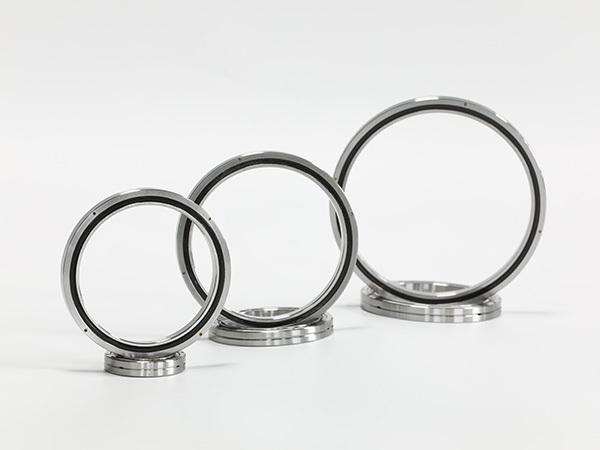
Modern equipment is becoming smaller, lighter, and more integrated. From robotics to medical devices, designers aim to reduce size without compromising performance. However, compact structures often face a major challenge — maintaining rigidity and rotational accuracy in limited installation space.
Traditional bearing arrangements may require multiple components to handle radial, axial, and moment loads. This increases design complexity and can introduce alignment errors during assembly. Over time, even slight misalignment can lead to vibration, uneven wear, and reduced positioning accuracy.
For compact precision systems, the right bearing design must provide both space efficiency and high stiffness.
How RA Cross Roller Bearings Solve Space and Load Challenges
An RA cross roller bearing is specifically designed for applications where installation space is limited but performance requirements are high. This type of bearing features a slim, lightweight structure with crossed cylindrical rollers arranged at right angles.
Because of this crossed roller configuration, a single bearing can support radial loads, axial loads, and moment loads simultaneously. The separable outer ring design simplifies mounting while maintaining excellent rotational accuracy. This makes it an ideal solution for compact, high-precision equipment.
Key Features That Improve Machine Performance
Slim and Lightweight Structure
The thin cross-section allows designers to reduce overall machine size without sacrificing load capacity or rigidity.
Separable Outer Ring Design
This design makes installation easier and improves assembly accuracy. It also helps reduce distortion during mounting.
High Rigidity and Stability
Crossed rollers provide line contact with raceways, increasing stiffness and minimizing elastic deformation under load.
Smooth and Accurate Rotation
Precision-ground raceways and controlled internal clearance reduce runout and vibration, improving motion control.
Comparison: Standard Bearings vs. RA Cross Roller Bearings
| Feature | Standard Ball Bearing | RA Cross Roller Bearing |
|---|---|---|
| Load Handling | Mainly radial | Radial, axial & moment loads |
| Space Requirement | Larger assembly | Slim, compact design |
| Rigidity | Moderate | High rigidity |
| Positioning Accuracy | General use | High-precision motion |
Choosing a compact, high-rigidity RA cross roller bearing can reduce system size while improving performance and reliability.
Industries That Rely on RA Cross Roller Bearings
Robotics and Automation
Robot joints and rotary actuators require compact bearings that maintain precision during rapid, repeated movements.
Medical Equipment
Imaging systems and surgical devices depend on smooth, precise rotation in limited installation spaces.
Optical and Measurement Devices
Precision instruments require minimal vibration and high rotational stability to ensure accurate readings.
Semiconductor Equipment
Chip manufacturing machines demand compact components with exceptional positioning accuracy and rigidity.
In these applications, both space efficiency and precision are critical for performance.
How to Choose the Right RA Cross Roller Bearing
Assess Available Installation Space
Measure housing dimensions carefully to select the correct thin-section bearing size.
Evaluate Combined Load Requirements
Ensure the bearing can handle radial, axial, and moment loads expected during operation.
Check Precision Grade
High-precision applications benefit from tighter tolerances and reduced rotational runout.
Consider Lubrication and Protection
Proper lubrication ensures smooth motion and long service life, while seals may be needed in contaminated environments.
Conclusion
As machines become more compact, the need for space-saving yet high-performance components increases. Bearings that cannot provide sufficient rigidity in small spaces will lead to vibration, alignment issues, and reduced equipment life.
RA cross roller bearings offer an effective solution by combining slim design, high load capacity, and excellent rotational accuracy. By selecting the right bearing, engineers can improve machine reliability, maintain precision, and extend service life — all within a compact structure.

 English
 French
 Spanish
 Portuguese
 Deutsch
 Turkish
 Dutch
Dutch
 Italiano
 Russian
 Romaian
 Portuguese (Brazil)
 Greek
Greek