
Custom ERP for Inventory and Supply Chain Optimization
Introduction
Inventory has a funny way of misbehaving too much of it and cash flow suffocates, too little and customers vanish faster than free coffee at a trade show. Businesses often juggle spreadsheets, outdated systems, and a hope that everything magically syncs overnight it rarely does. That’s where custom ERP enters the scene not as a flashy miracle cure, but as a carefully engineered backbone for operational sanity.
In this article, we’ll unpack how tailored ERP systems optimize inventory and supply chains, reduce inefficiencies, and bring clarity to chaos all without pretending technology alone fixes poor planning (it doesn’t).
The Inventory Problem No One Talks About
Let’s begin with a quiet confession: most inventory issues are self-inflicted. Overstocking “just in case,” underestimating seasonal spikes, or relying on disconnected tools creates operational blind spots.
And then comes the classic moment — warehouse shelves full, yet the one item a customer needs is missing.
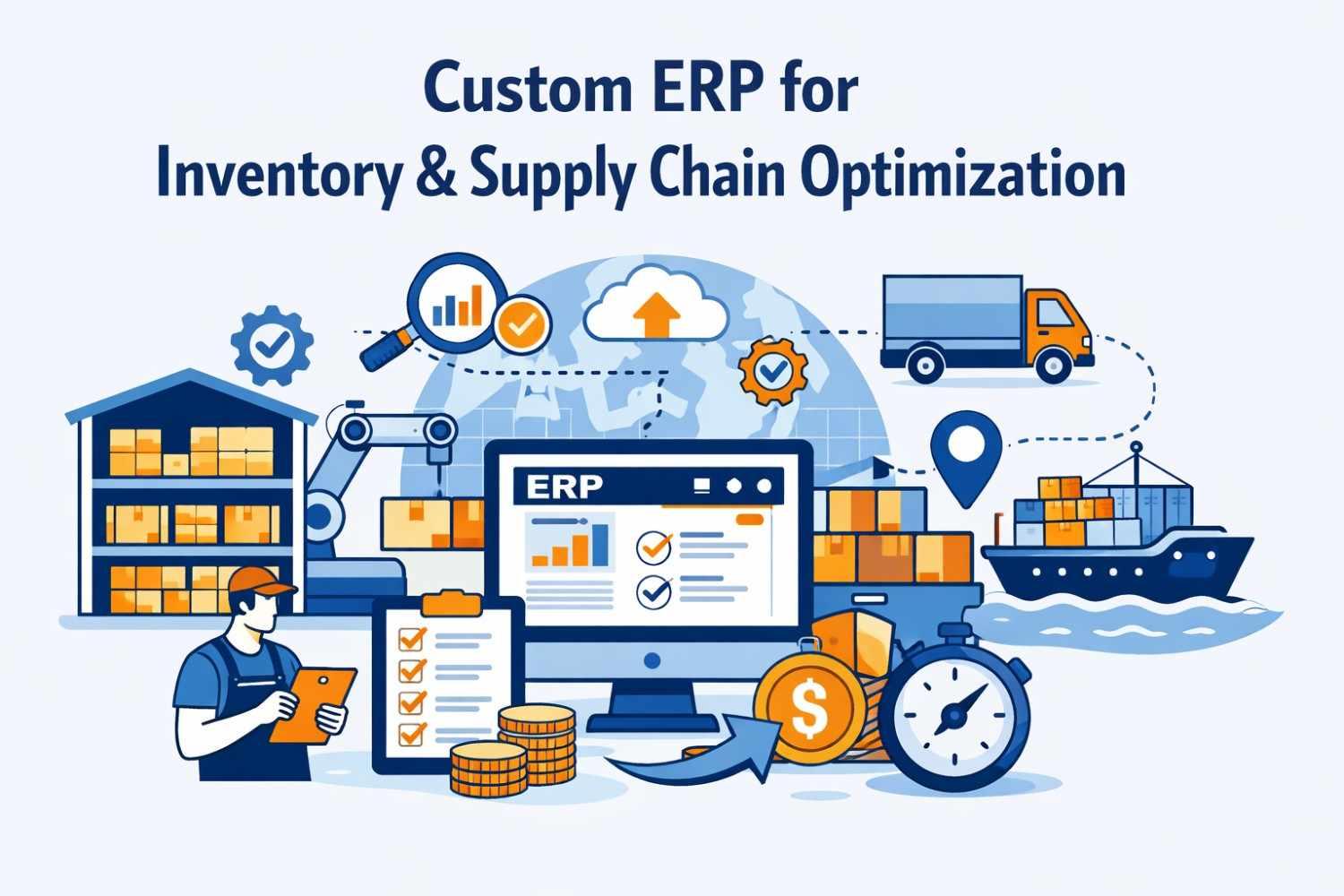
A custom ERP doesn’t just track numbers; it integrates procurement, warehousing, forecasting, and finance into a single source of truth. No more guessing. No more awkward “Let me check and call you back.” Instead, real-time visibility becomes the norm — and operational confidence follows.
Why Off-the-Shelf ERP Falls Short
Off-the-shelf ERP solutions promise speed and affordability. And to be fair, they deliver — until they don’t.
Generic modules often force businesses to adapt to software workflows that weren’t designed for their operational reality. Custom processes get squeezed into standardized templates. Growth exposes limitations. Integration gaps widen.
A Custom ERP Development Company can design workflows around actual supply chain logic — not theoretical best practices copied from another industry. The result? Fewer workarounds, fewer spreadsheets hiding in email attachments, and significantly fewer headaches.
Core Components of Inventory Optimization in Custom ERP
A well-designed ERP focuses on three pillars:
1. Real-Time Inventory Tracking
Stock levels update instantly across warehouses and sales channels. Decision-makers no longer operate on outdated reports.
2. Demand Forecasting and Analytics
Data patterns predict future requirements. Instead of reacting to shortages, businesses anticipate demand.
3. Automated Replenishment
Threshold-based alerts ensure reorder points are triggered intelligently — not emotionally.
Together, these features create a system that prevents stockouts, reduces carrying costs, and improves service levels — all while making operations feel surprisingly calm.
Supply Chain Optimization: Beyond the Warehouse
Inventory is only half the story. Supply chains involve vendors, logistics, transportation, compliance, and timelines — a delicate ecosystem where one delay cascades into multiple disruptions.
This is where Supply Chain Management ERP Software becomes transformative.
A tailored ERP connects suppliers, purchase orders, shipment tracking, and financial reconciliation into a unified flow. Delays become visible early. Costs become measurable. Vendor performance becomes quantifiable.
And suddenly, “We didn’t know” stops being a valid excuse.
The ROI Question (Because It Always Comes Up)
No serious business invests in ERP for fun. The inevitable question is: what’s the return?
Reduced stockholding costs.
Improved order fulfillment rates.
Lower manual labor expenses.
Better decision-making accuracy.
But here’s the understated benefit — peace of mind. When leaders can see operations clearly, strategic decisions improve. Growth becomes intentional rather than accidental.
ERP ROI isn’t dramatic; it’s incremental and compounding. And that’s precisely why it works.
Integration with Emerging Technologies
Modern ERP systems don’t operate in isolation. They integrate with:
-
AI-driven forecasting tools
-
IoT warehouse sensors
-
CRM platforms
-
E-commerce systems
-
Logistics APIs
This interconnected ecosystem transforms ERP from a record-keeping system into a predictive operations hub.
And yes, the future of supply chain management is data-driven — whether companies are ready or not.
A Personal Observation (The Spreadsheet Era)
Years ago, during a consulting session, a warehouse manager proudly showed off 17 color-coded Excel sheets tracking inventory. Seventeen. Each maintained by different people. Each slightly inconsistent.
The system worked — until someone forgot to update column G.
That moment made something clear: complexity disguised as control is still chaos. A custom ERP doesn’t eliminate complexity — it organizes it. And that distinction matters more than most executives realize.
Key Benefits of Custom ERP for Supply Chains
-
Centralized data visibility
-
Reduced human error
-
Improved vendor coordination
-
Accurate financial alignment
-
Scalability for growth
In other words, clarity replaces confusion.
And clarity, in business, is underrated.
Implementation Strategy: Where Most Projects Fail
ERP failures rarely stem from technology. They stem from poor planning.
Successful implementation requires:
-
Process mapping before development
-
Cross-departmental involvement
-
Clear KPIs
-
Phased deployment
-
Ongoing optimization
Custom doesn’t mean complicated — it means intentional.
And intentional systems outperform rushed deployments every time.
How Custom ERP Supports Business Growth
Growth introduces complexity — more SKUs, more suppliers, more warehouses, more markets. Without structured systems, expansion multiplies inefficiencies.
A scalable ERP architecture grows alongside operations. It adapts to multi-location management, international compliance, and demand variability.
Instead of rebuilding infrastructure every two years, businesses evolve within a stable framework.
That stability becomes a competitive advantage.
Security and Data Governance
Supply chains generate sensitive financial and operational data. Custom ERP systems can incorporate:
-
Role-based access controls
-
Data encryption
-
Audit trails
-
Compliance tracking
Security isn’t glamorous — but it’s foundational. And a tailored system ensures that governance policies align precisely with regulatory requirements.
Common Myths About Custom ERP
Myth 1: It’s Too Expensive
Long-term operational inefficiencies cost far more.
Myth 2: It Takes Years to Deploy
Modern development frameworks accelerate timelines significantly.
Myth 3: It’s Only for Large Enterprises
Mid-sized businesses often benefit the most due to agility and scalability needs.
Conclusion
Inventory chaos rarely announces itself — it creeps in quietly, disguised as “temporary fixes” and “quick solutions.” Over time, those patches become structural weaknesses.
Custom ERP doesn’t promise perfection. It promises visibility. It offers structure where there was once guesswork. And it transforms supply chain management from reactive firefighting into proactive strategy.
Optimization isn’t about working harder; it’s about working intelligently — with systems that support growth instead of slowing it down.
And if there’s one recurring lesson in operations, it’s this: clarity scales. Confusion compounds. Choose
Frequently Asked Questions (FAQs)
1. What is custom ERP in supply chain management?
Custom ERP is a tailored enterprise system designed specifically around a company’s inventory workflows, procurement processes, and distribution strategies.
2. How does custom ERP reduce inventory costs?
By enabling real-time tracking, forecasting accuracy, and automated replenishment, it prevents overstocking and stockouts.
3. Is custom ERP suitable for small businesses?
Yes, especially growing businesses needing scalable systems aligned with unique operations.
4. How long does ERP implementation take?
Typically 3–9 months depending on scope, integrations, and organizational readiness.
5. What industries benefit most?
Manufacturing, retail, logistics, distribution, and e-commerce sectors see significant gains.
6. Can ERP integrate with existing software?
Yes, custom systems are built with API compatibility to integrate CRM, accounting, and logistics tools.

 English
 Arabic
 French
 Spanish
 Deutsch
 Turkish
 Dutch
Dutch
 Italiano
 Russian
 Romaian
 Portuguese (Brazil)
 Greek
Greek