
What Happens After Your CRM No Longer Fits the Business
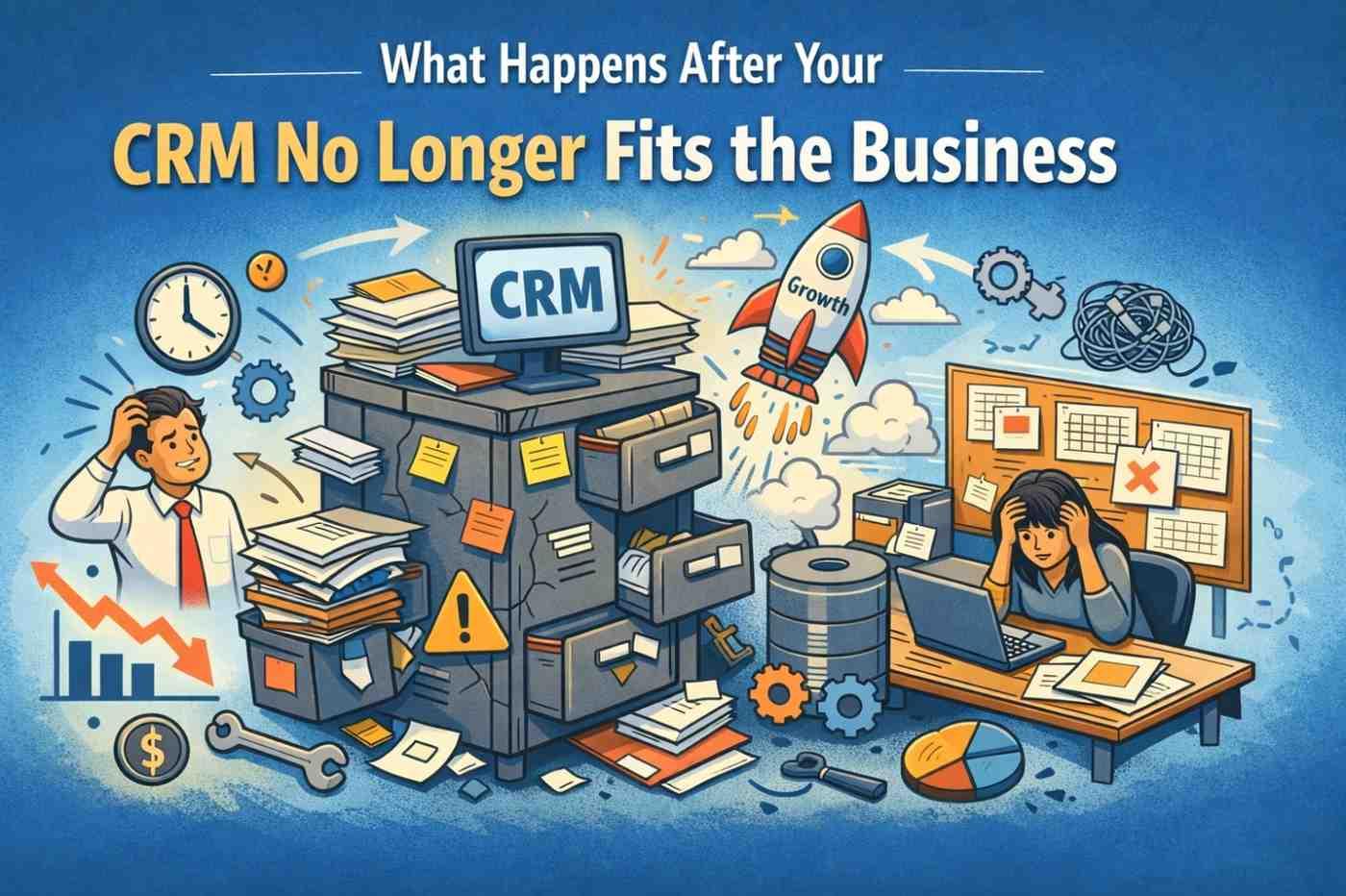
Every CRM starts with promise dashboards look clean, workflows feel logical, and everyone agrees this will fix everything. Then the business grows. New teams appear, processes evolve, customers expect faster responses, and suddenly the CRM feels less like a system and more like a speed bump. Reports take longer, workarounds multiply, and confidence quietly erodes. Growth is supposed to feel exciting, not restrictive. When a CRM no longer fits the business, the impact shows up everywhere—operations, customer experience, and even team morale—often long before leaders consciously acknowledge the problem.
The Honeymoon Is Over: Why CRMs Age Faster Than Expected
Most CRMs are adopted based on today’s needs, not tomorrow’s complexity. What works perfectly for a small sales team can struggle under new markets, products, and customer segments. As workflows evolve, rigid data models begin to crack. Features that once felt helpful start feeling excessive, while essential capabilities remain missing. Businesses rarely “outgrow” a CRM overnight; the system slowly drifts out of alignment. Like office furniture bought during a startup phase, the CRM simply wasn’t designed for the version of the business that exists now.
Warning Signs Your CRM Is Holding the Business Back
Clear signals appear when a CRM stops supporting growth. Teams rely heavily on spreadsheets for reporting. Simple changes require developer help. Data lives in multiple places with no single source of truth. Sales complains about visibility, marketing questions attribution, and leadership hesitates before trusting dashboards. None of these problems sound catastrophic individually, which makes them easy to ignore. Together, they create friction that slows execution. When a tool designed to increase efficiency begins demanding extra effort, it quietly shifts from asset to liability.
Operational Side Effects Nobody Talks About
An outdated CRM doesn’t just frustrate users—it reshapes operations in subtle ways. Decision-making slows as leaders wait for “cleaner” data. Opportunities slip through gaps because handoffs are unclear. Customer interactions feel inconsistent, even when teams try their best. Over time, processes bend to accommodate system limitations instead of business priorities. That adaptation becomes normalized, which is dangerous. Efficiency loss rarely announces itself loudly; it hides in delayed follow-ups, manual checks, and meetings spent reconciling numbers instead of acting on them.
The Human Cost: Adoption Drops and Shadow Systems Appear
People naturally avoid tools that make work harder. When CRM usage feels burdensome, teams create alternatives—notes apps, personal trackers, shared spreadsheets. These shadow systems solve immediate pain but introduce long-term chaos. Data accuracy declines, collaboration weakens, and onboarding new hires becomes harder than necessary. Morale also takes a hit. Employees start believing leadership values tools over reality. No system failure damages productivity faster than a tool people actively resist using, even when expectations say otherwise.
Why “Just Add a Plugin” Stops Working
Plugins and extensions feel like quick wins. One more add-on promises automation, reporting, or customization without disruption. Eventually, those patches create technical debt. Performance drops, integrations conflict, and security risks increase. Maintenance costs rise while flexibility decreases. Each fix solves a symptom rather than the underlying misalignment. Over time, the CRM becomes fragile—any update risks breaking something else. What once felt adaptable turns rigid, proving that incremental fixes cannot compensate for foundational design limits.
The Turning Point: Re-evaluating CRM Strategy
Every growing business reaches a moment where strategy must replace improvisation. CRM evaluation shifts from feature lists to workflow alignment. Questions become sharper: How does data move between teams? What decisions depend on real-time insight? Which processes define competitive advantage? This is often where custom CRM development enters the conversation—not as a trend, but as a response to reality. Systems built around actual operations offer clarity where generic platforms struggle. The goal is not complexity, but fit.
What Businesses Usually Try First (And Why It Half-Works)
Switching to another off-the-shelf CRM often seems logical. Migration feels safer than reinvention. Results are mixed. New tools solve old frustrations while introducing fresh constraints. Customization helps temporarily, but core limitations remain. Costs climb as configuration grows more complex. Teams repeat the same learning curve with a different interface. Progress happens, yet expectations fall short. These experiences often confirm a hard truth: replacing one rigid system with another rarely delivers lasting alignment.
Rebuilding for Reality, Not the Pitch Deck
Systems perform best when designed around real behavior, not idealized workflows. Building from actual processes reveals what truly matters—approvals, exceptions, reporting logic, and customer touchpoints. This approach removes unnecessary features while strengthening critical ones. Custom CRM development allows data structures, permissions, and integrations to match how teams actually work. Flexibility becomes intentional, not accidental. Instead of adapting people to software, the software adapts to people, restoring efficiency and trust across departments.
Migration Without the Meltdown
Change creates anxiety, especially when core systems are involved. Successful CRM transitions prioritize clarity over speed. Data is audited before migration, not after. Teams are trained gradually, not overwhelmed all at once. Parallel systems run briefly to reduce risk. Communication stays transparent, setting realistic expectations. Resistance decreases when users understand the “why” behind change. A well-managed migration doesn’t feel disruptive; it feels relieving—like finally removing a constraint everyone quietly learned to tolerate.
Measuring Success After the Switch
Success is not defined by launch day. Real measurement happens weeks later. Adoption rates reveal usability. Reporting accuracy shows data integrity. Cycle times reflect operational improvement. Feedback loops uncover friction early. Strong systems reduce meetings, not increase them. Decisions feel faster and more confident. When CRM metrics align with business outcomes, confidence returns. Teams stop asking whether the system works and start relying on it instinctively—a subtle but powerful shift that signals true success.
The Long View: Building a CRM That Grows With You
Sustainable systems anticipate change. Modular architecture supports expansion without disruption. Clear documentation prevents knowledge silos. Ownership of data ensures long-term flexibility. Custom CRM development supports this mindset by enabling evolution instead of replacement. Growth becomes an expected condition, not a breaking point. Businesses that plan for adaptability avoid repeating the same cycle every few years. Tools become partners in growth rather than obstacles, creating stability even as complexity increases.
Conclusion: Tools Should Adapt to People, Not the Other Way Around
CRMs fail quietly long before they fail publicly. What starts as inconvenience turns into operational drag, then strategic risk. Recognizing the moment a system no longer fits is not a failure—it’s awareness. Growth demands alignment, and alignment demands honesty about what no longer works. The right CRM does more than store data; it supports momentum. When tools reflect reality, teams move faster, decisions improve, and growth feels like progress again—not resistance disguised as software.
FAQs
What is the first sign that a CRM no longer fits a business?
Frequent workarounds, manual reporting, and declining user adoption are usually the earliest indicators.
Can an existing CRM be fixed instead of replaced?
Minor gaps can be addressed, but structural limitations often require deeper redesign or rebuilding.
How long does a CRM transition usually take?
Timelines vary, but well-planned transitions typically range from three to six months.
Is a custom CRM only for large enterprises?
Mid-sized businesses often benefit the most due to operational complexity and growth needs.
Does a new CRM guarantee better results?
Results improve when the system aligns with real workflows and is supported by proper change management.

 English
 Arabic
 French
 Spanish
 Portuguese
 Deutsch
 Turkish
 Italiano
 Russian
 Romaian
 Portuguese (Brazil)
 Greek
Greek